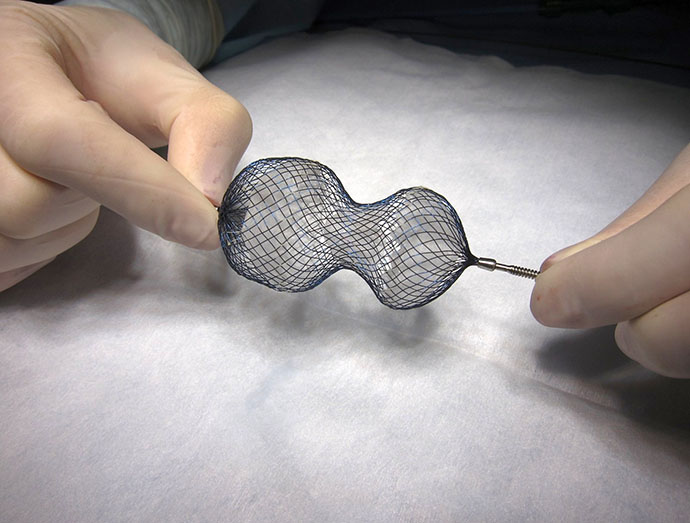
What is it? occluder?
A miniature nitinol implant, thinner than a coin. It travels through a vessel to the heart, unfolds—and closes the hole the child has had since birth. No open surgery, no scar.
Scalpel‑free surgery
Septal heart defects (atrial septal defect, ventricular septal defect, patent foramen ovale) can be treated in the X‑ray operating suite during interventional catheterization using various endovascular devices. These procedures can serve as an alternative to open‑heart surgery (with cardiopulmonary bypass). All devices are assembled into a thin catheter that is introduced through the vessels into the heart chambers. Endovascular devices are made of fine metal (some incorporate fabric) and possess shape‑memory properties. This means that once released inside the heart chambers they return to their original shape. Consequently, sufficiently large devices can be delivered to the defect through a slender delivery system. Catheters carrying the devices are advanced through the vessels into the heart chambers, where they close the septal defects. The implant functions as a scaffold on which heart cells can grow, eventually covering it completely over time. Therefore, for a period after implantation patients need to take aspirin, which prevents clot formation until their own cells fully cover the implant.
In our department’s X‑ray operating suite, we carry out the full spectrum of minimally invasive cardiovascular procedures for children and adults, both diagnostic and therapeutic.
We perform:
1. Diagnostic cardiac catheterization
2. Balloon dilation of aortic coarctation
No incision
Access was achieved through a vessel puncture. The child will be home in just a few days.
Forever
The occluder remains in the heart and, over time, becomes covered with the child’s own tissues.
A defect is not a verdict
After the surgery, the child lives a full life and is no different from peers. Contact us for a consultation — the foundation will help.
One occluder — one saved heart
Acquiring the implant — exactly what the foundation is raising funds for. Join us.
Donate